
A Digital Bill of Rights for the States
A Model Amendment to State Constitutions for the Age of Artificial Intelligence


A Model Amendment for the State Constitutions of the Several States — a Digital Bill of Rights each state can adopt into its own constitution. The bracketed placeholder “[your state here]” marks each point where an adopting state inserts its own name; the text is a floor to be strengthened, not a ceiling. Drafted by Courtenay Turner and Patrick Wood.
This document is free to read, share, print, and adopt — and always will be. It carries no paywall and asks nothing of you but that you use it. If you are a legislator, a staffer, or a citizen who wants to bring it to your statehouse, take it. Strengthen it. Make it yours.

Download the full text (PDF) ↓

Printer Friendly (PDF)
Read the analysis: The America at 250 Series
🔴⚪️🔵 Happy Birthday, America. Now Hand Over Your Sovereignty.
🔴⚪️🔵 America at 250, Part II: The Implementation
🔴⚪️🔵 America at 250, Part III: The Counter-Liturgy
🔴⚪️🔵 America at 250, Part IV: The Ratification
On July 4, 2026, on the 250th anniversary of the Declaration of Independence, a set of institutions published a new founding document for the age of artificial intelligence. It proclaims the primacy of the human person — and then, principle by principle, makes that primacy something secured through a certification apparatus: standards to be met, a rating to be earned, an index to be scored, an order to be joined. Read closely, it converts a dignity that no power was supposed to be able to grant or withdraw into a status that an administering body confers, measures, and keeps. That is the quiet move this document was written to answer.
The answer cannot be a better certification scheme, because anything that secures the human person through an administering body has already conceded the point: whatever such a body secures, it can also condition and withdraw. The only structural answer is an instrument that refuses to be the source of the rights it protects — one that declares those rights already possessed, endowed by their Creator, antecedent to all government and to every technology, and beyond the reach of anything that could administer them. That is what this Digital Bill of Rights is: not a grant of rights, but a declaration of rights the People already hold, written so that no repeal, reinterpretation, or technological development can construe them away.

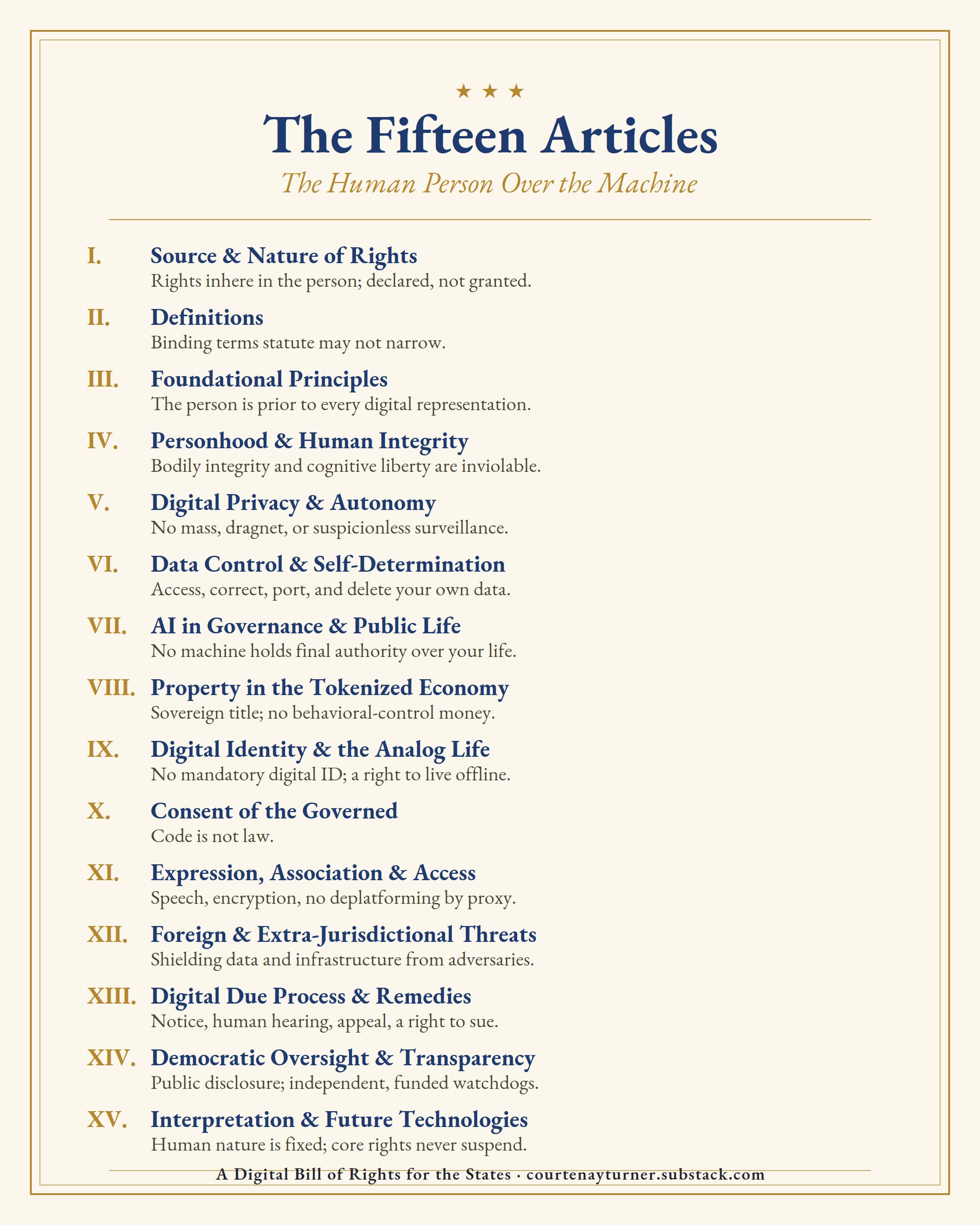
It is a model amendment to state constitutions — a Digital Bill of Rights each state can write into its own constitution, not a proposed federal amendment. The choice of the states is deliberate. A firewall against a transnational architecture is not built at the summit, where compacts and constitutions-for-humanity are convened; it is built at the level nearest to consent, where the routing-around is hardest. A right secured in fifty state constitutions, enforceable in fifty state courts, is a right no single venue can convert — because there is no single venue that everything must pass through. Its fifteen articles fix personhood to human beings, place the body and the mind beyond coerced technological intrusion, bar programmable money designed for behavioral control, guarantee the right to an analog life, keep code from carrying the force of law, and anchor every protection in a human nature that technology may not redefine.
Use it. This is a floor, not a ceiling — written to be strengthened by any legislature that adopts it, carried to any statehouse by any citizen who wants it there. The bracketed “[your state here]” marks where an adopting state inserts its name. The full text follows. If you want the argument behind it — a reading of the July 4 document it answers — it is in America at 250, Part IV, linked above and below.
— Courtenay Turner
Digital Bill of Rights
A Strengthened Model Amendment to State Constitutions for Adoption by the Several States — Aligned with the Metaphysics of the Declaration of Independence
Preamble
The People of [your state here] hold these truths to be self-evident: that all human beings are created equal; that they are endowed by their Creator with certain unalienable rights, among them life, liberty, conscience, and property both private and sovereign; that these rights inhere in the human person by nature, are antecedent to all government and to every technology, and can neither be granted nor extinguished by any human institution; and that governments are instituted among men to secure these rights, deriving their just powers from the consent of the governed.
Recognizing that the digital domain has become inseparable from the exercise of liberty, property, conscience, and self-government, and that data systems, automated decision-making, programmable financial instruments, and emerging biotechnologies now possess the capacity to surveil, manipulate, exclude, redefine, and coerce on a scale unknown to prior generations, the People do ordain and establish this Digital Bill of Rights as an integral part of the Constitution of this State — not to create rights, but to declare and secure rights the People already possess.
Its purpose is to secure the primacy of the human person over machines, the integrity of the human body and mind against coerced technological intrusion, the integrity of private property against digital obfuscation, the consent of the governed against rule by technique, and the freedom of the People from surveillance, manipulation, and behavioral control in the digital age. This instrument shall be construed at all times to maximize liberty and to resist its diminution.
Findings and Purpose
The People of [your state here] find and declare:
Digital systems now mediate access to ordinary civic, economic, educational, financial, medical, and social life.
Exclusion from digital identity, digital payment, digital communications, automated eligibility systems, or essential digital infrastructure may function as exclusion from the practical exercise of constitutional rights.
Data systems, biometric systems, automated decision systems, programmable financial instruments, and identity architectures can be used to surveil, score, manipulate, exclude, or coerce persons without the visible force historically associated with government power.
Rights antecedent to government do not lose their character when exercised through digital means, stored in digital form, or mediated by digital infrastructure.
The State has a compelling sovereign interest in securing the rights, liberties, property, bodily integrity, cognitive liberty, and self-government of its residents against digital systems that would convert unalienable rights into conditional privileges.
This Digital Bill of Rights is adopted to preserve the primacy of the human person, the consent of the governed, and the constitutional order of this State in the digital age.
Article I — Source and Nature of Rights
Section 1. Source of Rights. The rights secured by this Digital Bill of Rights inhere in the human person by nature and by endowment of the Creator. They are antecedent to all government, to all law, and to every technology. This instrument declares and secures these rights; it does not create them, and no repeal, amendment, reinterpretation, or technological development shall be construed to extinguish them. Government in [your state here] exists to secure these rights and derives its just powers from the consent of the governed. No power inconsistent with that purpose is granted herein, and none shall be implied.
Section 2. Equality and Indivisibility of Persons. All human beings are created equal in nature, dignity, and rights. Personhood is not gradable, and the rights secured herein do not vary with cognitive capability, genetic profile, health status, disability, age, or the presence or absence of technological augmentation. No person shall enjoy superior legal status by virtue of technological enhancement, and no person shall suffer diminished legal status by virtue of declining it.
Section 3. Non-Alienation and the Limits of Consent. No consent, waiver, contract, license, employment condition, educational condition, terms of service, clickwrap or browsewrap agreement, arbitration clause, benefit condition, grant condition, procurement term, insurance term, platform rule, or technological protocol shall be construed to surrender, assign, extinguish, diminish, or permanently encumber any right secured by this Bill. Any provision purporting to do so is void as against public policy to the extent of the impairment. Consent may authorize only a specific, limited, revocable, and purpose-bound act otherwise consistent with this Bill; it shall never operate as alienation of the underlying right, and the right of revocation may not be waived. Refusal or withdrawal of consent shall not result in penalty, exclusion from essential services, loss of legal status, or materially degraded access to ordinary civic, economic, educational, or social life.
Section 4. No Adverse Inference from the Exercise of a Right. No adverse inference, presumption, score, risk designation, eligibility reduction, investigative trigger, reputational penalty, financial penalty, denial of service, increased scrutiny, or differential treatment shall arise from a person’s refusal to adopt, present, use, carry, fund, maintain, or interact through a digital identity credential, biometric system, programmable payment instrument, neural interface, automated decision system, tokenized title system, surveillance technology, or other digital mechanism that this Bill protects against compulsion. The lawful exercise of any right secured by this Bill shall not itself be treated as suspicious, and shall not be used as a factor, input, or justification in any decision, classification, or enforcement action by a government entity.
Article II — Definitions
As used in this Digital Bill of Rights, the following terms have the meanings set forth below. These definitions are binding rules of construction and may not be narrowed by statute, regulation, contract, or administrative interpretation.
Entity. Any natural person, corporation, partnership, association, trust, foundation, platform, vendor, contractor, financial institution, educational institution, healthcare provider, insurer, employer, governmental body, foreign entity, or other legal or commercial actor, whether public or private.
Human person; natural person. A living member of the human species, whatever the person’s stage of development, capability, health, or degree of technological augmentation. The terms do not include any artificial intelligence, algorithm, robot, software agent, or synthetic entity, nor any digital representation, simulation, or replica of a person.
Synthetic entity. Any artificial intelligence, machine-learning system, software agent, robot, autonomous system, digital twin, avatar, simulation, or other artifact of human or machine fabrication that exhibits or emulates intelligent behavior, whatever its degree of autonomy, capability, or claimed sentience.
Personal data. Any information that identifies, relates to, describes, is reasonably capable of being associated with, or could be linked — directly or indirectly, alone or in combination — to a particular natural person or household, including identifiers, communications content and metadata, biometric and genetic information, behavioral and inferred data, financial records, location data, and digital activity logs.
Neural data. Data generated by, derived from, or measuring the activity or structure of a person’s central or peripheral nervous system, and any data or inference concerning a person’s mental states, thoughts, emotions, or cognitive processes derived therefrom.
Neurotechnology. Any device, system, or technique capable of recording, decoding, interpreting, stimulating, modulating, or altering the activity of the nervous system, whether implanted, wearable, or remote.
Emotion recognition; affective computing. Any automated system that detects, infers, classifies, or predicts a person’s emotions, mood, attention, engagement, intentions, psychological states, or personality traits from biometric, behavioral, physiological, neural, or expressive data.
Digital identity credential. Any digital record, token, certificate, application, or system — public or private — used to identify a person or to verify the person’s identity, attributes, status, credentials, or entitlements, including mobile identification, verifiable credentials, digital wallets containing identity attributes, and biometric identifiers used for identification.
Government entity. The State, every county, municipality, special district, and political subdivision; every branch, department, agency, and officer thereof; and any contractor, grantee, vendor, or private partner to the extent it performs a function on behalf of, at the direction of, or with material assistance from any of the foregoing.
State action. Conduct by a government entity and, in addition, conduct by a private party where a government entity has coerced, commanded, or provided significant encouragement for the conduct, has delegated to the private party a function traditionally and exclusively governmental, or has acted jointly with the private party such that the two are jointly responsible for the challenged conduct.
Essential services. Services without reasonable substitute that a person requires for ordinary participation in economic, civic, or social life, including but not limited to electricity, water, heating, banking and payment access, employment, housing, healthcare, education, emergency services, telecommunications and internet access, and access to government benefits, licenses, and permits.
Materially affect. To alter, condition, or have a reasonable likelihood of altering or conditioning a person’s rights, liberties, property, livelihood, reputation, safety, or access to essential services or opportunities, whether the effect is immediate or reasonably foreseeable.
Automated decision system. Any computational process, including one derived from or using artificial intelligence, machine learning, statistical modeling, or algorithmic logic, that issues, supports, recommends, or substitutes for a decision, classification, score, ranking, or prediction concerning a person.
Surveillance. The collection, interception, acquisition, monitoring, recording, retention, aggregation, or analysis of personal data or of a person’s communications, location, movements, associations, or conduct.
Covert. Conducted, funded, coordinated, or directed in a manner not plainly and contemporaneously disclosed to the persons affected such that a reasonable person would not know of the actor’s identity, role, or purpose.
Freely given consent. Consent that is specific, informed, unambiguous, and revocable, given by affirmative act, and obtained without coercion. Consent is not freely given where it is a condition of access to essential services, where it is bundled with unrelated terms, where refusal carries a penalty or materially degraded service, or where it is extracted by a party holding a dominant position in the relevant market.
Programmable money. Any unit of monetary value or payment instrument — public or private, physical or digital, including central bank digital currencies, corporate digital currencies, stablecoins, tokens, and smart-contract-based instruments — whose use, transfer, value, or validity can be conditioned, restricted, expired, redirected, or monitored by its issuer or a third party after issuance, whether or not such capability is presently activated.
Behavioral control. The use of any payment, financial, or data system to condition, restrict, penalize, reward, or direct a person’s lawful choices on the basis of that person’s conduct, social credit, political or religious views, health status, location, associations, environmental scoring, or other personal attributes.
Tokenization. The representation of an ownership interest in property by a digital token, entry, or instrument recorded on a blockchain, distributed ledger, or comparable technology.
Sovereign property. Property held as an extension of the natural dominion of the human person — antecedent to, and not constituted by, contract — such that the root right of ownership participates in the unalienable character of natural right itself. Particular interests in sovereign property may be voluntarily transferred by the owner, but the underlying right of ownership may not be alienated, extinguished, or waived by contract, technological condition, or governmental act. The term “private property” as used in this Bill is understood to carry this sovereign character. Nothing in this definition prevents the voluntary sale, lease, license, inheritance, mortgage, or transfer of particular property interests by the owner, nor the lawful exercise of taxation, police power, or eminent domain consistent with due process and just compensation. Its purpose is to prevent the underlying human right of ownership from being extinguished, obscured, or converted into a revocable platform permission by contract, tokenization, digital architecture, or administrative rule.
Foreign adversary. Any foreign government or non-state actor, and any entity owned by, controlled by, or subject to the jurisdiction or direction of such government or actor, that is designated as a foreign adversary under applicable federal law, or that the Legislature or its designated body finds to engage in a long-term pattern of conduct hostile to the security, sovereignty, or constitutional liberties of the United States or this State. Designations shall be public, evidence-based, and subject to periodic review.
Strictly necessary; narrowly tailored. Limited to the least intrusive means reasonably available to achieve a specific, compelling, and lawful objective, no broader in scope, duration, or population affected than that objective requires, and supported by particularized findings.
Article III — Foundational Principles
Section 1. Primacy of the Human Person. All rights guaranteed by this Constitution extend fully and equally to every human person’s activities, communications, data, and identities expressed or stored in digital form. The human person is prior to every digital representation of the person; rights attach to the person, never to the artifact. No digital identity, profile, account, avatar, digital twin, or data representation is a person or possesses rights; such representations are artifacts subject to the rights and control of the human person they represent. Human beings — not algorithms, machines, or synthetic entities — shall remain the final authority in all matters of governance, justice, and the exercise of coercive power within [your state here]. No government entity, and no private party acting under this Bill or under statutes enacted to implement it, shall diminish, waive, or condition constitutional rights as a prerequisite for accessing essential services, employment, education, or civic participation in digital environments.
Section 2. Scope, Application, and the Duty to Legislate. This Digital Bill of Rights binds all branches and levels of government in [your state here] — state, county, municipal, and special districts — and all conduct constituting state action. The Legislature shall enact, and is hereby directed to enact, statutes extending the protections of this Bill to the conduct of private actors — including corporations, partnerships, associations, and foreign entities — to the fullest extent of the State’s lawful authority, in the domains of essential services, regulated industries, state contractors and grantees, fiduciary holders of personal data, payment and financial systems, employment, education, housing, healthcare, insurance, credit, utilities, and identity infrastructure, and in such other domains as the Legislature finds to involve comparable private control over essential participation in civic, economic, or social life. Pending such legislation, the provisions of this Bill that govern private conduct shall be directly enforceable to the maximum extent permitted under the Constitution of the United States. Any contract, terms of service, or agreement that purports to waive or substantially impair rights guaranteed herein shall be void as against public policy and unenforceable to the extent of the impairment.
Article IV — Personhood and Human Integrity
Section 1. Exclusivity of Human Personhood. Legal personhood, the rights secured by this Constitution, and standing to assert them belong exclusively to human persons. No synthetic entity shall be recognized as a person; granted legal personhood, rights, or standing; permitted to hold title to property in its own right; or appointed to any office or position of public authority — regardless of its capability, autonomy, apparent intelligence, or claimed sentience, and regardless of any contrary designation by contract, charter, foreign law, or external regulation, to the fullest extent the Constitution of the United States permits. No corporation, partnership, association, trust, foundation, decentralized autonomous organization, or other juridical entity shall be recognized, organized, licensed, or permitted to act within [your state here] where the practical control, beneficial ownership, voting power, governance authority, or decision-making authority of that entity is vested in, delegated to, or effectively exercised by a synthetic entity. Juridical personhood exists only as a procedural instrument for the association, accountability, and property interests of human persons, and shall not be used to confer standing, ownership, governance authority, or rights upon a synthetic entity by indirection. Nothing in this Section disturbs the recognition of corporations, partnerships, and associations as juridical persons; such recognition is a procedural convention for the collective action and accountability of human persons, asserts no ontological claim, and shall not be extended, by analogy or otherwise, to confer personhood or rights upon any autonomous synthetic entity.
Section 2. Bodily Integrity. Every human person has the right to the integrity of his or her own body. No person shall be required, as a condition of employment, education, essential services, travel, commerce, civic participation, or access to any public place or benefit, to accept, carry, or submit to any implanted, ingested, or affixed device; biometric augmentation; neural interface; or any other biological–digital integration. No government entity shall mandate the genetic, biological, or technological modification or augmentation of any human person, nor condition any right, benefit, or service upon such modification. No person shall be subjected to discrimination, denial of services, or differential treatment on the basis of genetic information, or on the basis of declining any enhancement, augmentation, implantation, or biological–digital integration.
Section 3. Cognitive Liberty and Mental Privacy. The freedom of thought is absolute. The inner mental life of the human person — thought, belief, emotion, and conscience — is inviolable and beyond the reach of every government entity and every private actor. Neural data constitutes the most protected class of personal data under this Bill: it may be collected or processed only with the freely given consent of the person in each instance; it may never be sold; and it may never be collected, used, or disclosed to decode, infer, predict, or manipulate a person’s mental states against that person’s interests or without that person’s knowledge. No government entity shall employ neurotechnology to monitor, interrogate, manipulate, or punish any person, under any circumstance. Except as provided below, no private actor shall employ neurotechnology upon any person for purposes of surveillance, identification, interrogation, monitoring, decoding, inference, prediction, manipulation, stimulation, modulation, behavioral control, scoring, discipline, eligibility determination, or access control. No consent shall be valid where the use of neurotechnology is made a condition of employment, education, housing, credit, insurance, healthcare access, essential services, public accommodations, legal status, civic participation, or ordinary commercial participation. Notwithstanding the foregoing, nothing in this Section prohibits a person-initiated medical, therapeutic, assistive, or accessibility use of neurotechnology, provided that such use is specific, informed, revocable, narrowly limited to the purpose requested by the person or the person’s lawful guardian, and not used to build, train, sell, disclose, or contribute to any profiling, prediction, scoring, disciplinary, or behavioral-control system.
Section 4. Prohibition of Emotion Recognition and Psychometric Profiling. No government entity shall deploy emotion recognition or affective computing upon any person. No emotion recognition, affective computing, or psychometric, behavioral, or social-emotional profiling shall be conducted upon any person in the contexts of employment, education, healthcare, insurance, credit, housing, or access to essential services. No educational institution, and no vendor, platform, or contractor providing services to one, shall subject any student to emotion recognition, affective computing, or the collection, analysis, or scoring of social-emotional, psychological, or behavioral data for purposes of profiling, prediction, or intervention. This prohibition is not subject to consent. Nothing herein prevents an individualized educational or health service that a student’s parent or guardian has specifically and separately requested, and that is not used to build or train any profiling, prediction, or scoring system.
Article V — Digital Privacy and Autonomy
Section 1. Right to Digital Privacy. Every person has the right to be secure in their digital persons, houses, papers, effects, communications, devices, online accounts, and data against unreasonable searches, seizures, access, or monitoring. No surveillance or data acquisition by any government entity shall occur except pursuant to a warrant issued upon probable cause, supported by oath or affirmation, and particularly describing the data, devices, accounts, or systems to be searched and the information to be seized. This protection applies regardless of whether the data is held by the person, by a third party, or by a service provider; the fact that data has been shared with or is held by a third party does not diminish its protection. General warrants and the bulk collection of data not tied to specific persons or particularized suspicion are categorically prohibited and admit of no exception. No government entity shall purchase, solicit, accept, or otherwise acquire from any third party — including a data broker, platform, contractor, or vendor — any personal data that the government entity would be required to obtain by warrant if it collected the data directly; acquisition in violation of this provision is unlawful surveillance.
Section 2. Protection from Mass and Ubiquitous Surveillance. Persistent, indiscriminate, or dragnet surveillance of the population is prohibited and admits of no exception. Such prohibited surveillance includes mass interception of communications, mass location tracking, real-time or untargeted facial recognition, untargeted biometric identification, and population-scale behavioral monitoring. Targeted use of facial recognition or biometric identification directed at a specific, identified person is permitted only pursuant to a warrant meeting the requirements of Section 1, and may never be conducted on an untargeted or population-wide basis. The deployment of surveillance technologies in public spaces — including cameras, sensors, automated license plate readers, and similar devices — shall be limited by clear statutory standards, disclosed publicly in advance, subject to democratic approval by the relevant legislative body, and constrained to protect anonymity and freedom of association. Data gathered for one specific, lawful, narrowly defined purpose shall not be repurposed, retained beyond that purpose, or combined with other datasets in any manner that expands surveillance or profiling, absent fresh, freely given consent of each affected person or a new warrant meeting the requirements of Section 1.
Section 3. Digital Autonomy and Freedom from Manipulation. Every person has the right to be free from covert digital manipulation by any government entity, contractor, or corporation operating within or materially affecting [your state here], including covert psychological operations, behavioral conditioning, or algorithmic targeting intended to shape beliefs, emotions, or conduct without disclosure. Government entities and their partners are prohibited from engaging in: (a) covert censorship-by-proxy, including the secret coordination with, or coercion of, private platforms to suppress lawful speech or viewpoints; (b) covert influence operations or astroturfing campaigns targeting residents through bots, fake personas, undisclosed sponsored content, or deceptive synthetic media; and (c) the manipulation of news feeds, search results, or information visibility through undisclosed algorithmic means to favor or disfavor political, ideological, or religious viewpoints. Any digital content, service, or interface operated, funded, or directed by a government entity that seeks to influence behavior shall clearly and contemporaneously disclose its governmental origin, its purpose, and any use of algorithmic personalization or targeting. Ordinary, transparent government communication and routine administrative interface design that does not covertly exploit cognitive bias to a person’s detriment are not prohibited by this Section.
Section 4. Prohibition of Suspicionless “Reverse” and Dragnet Warrants. Reverse-location, geofence, reverse-keyword, reverse-biometric, or comparable warrants that identify persons first and establish particularized suspicion afterward are prohibited. No warrant shall issue that compels the production of a list of persons, devices, accounts, or searches defined by presence in a geographic area, use of a search term, or possession of a characteristic, rather than by particularized suspicion as to a specific, identified person or device. Any search or acquisition of this kind is permitted only where it is directed to a specific, identified person or device upon probable cause and particularized suspicion, and meets the warrant requirements of Section 1.
Article VI — Data Control, Integrity, and Self-Determination
Section 1. Inalienable Rights in Personal Data. Each person holds inalienable rights of privacy, control, and self-determination over their personal data. These rights are personal to the individual and may not be permanently surrendered, assigned, or extinguished; any purported transfer of data does not extinguish the originating person’s continuing rights of access, correction, deletion, and control set forth herein. No entity operating within, offering goods or services within, contracting within, receiving public funds from, or materially affecting residents of [your state here] may collect, process, sell, transfer, or retain the personal data of residents of [your state here] except upon freely given consent, or pursuant to a warrant, a court order, or a narrowly defined statutory duty that is consistent with this Constitution, and subject to strict necessity and proportionality. Every person has the right to access, correct, port, download, and delete their personal data held by any entity, subject only to narrowly tailored, time-limited exceptions for due process, legitimate and warrant-backed law enforcement needs, or explicit statutory requirements.
Section 2. Data Minimization, Security, and Retention. Entities shall collect only the minimum personal data necessary to deliver a service the person has requested or to fulfill a clearly defined legal obligation. Mandatory retention of personal data beyond what is necessary for the explicitly stated purpose is prohibited, except where narrowly required by law and subject to judicial and legislative oversight. Personal data shall be stored securely, encrypted in transit and at rest, and protected against unauthorized access; breaches shall be disclosed promptly to affected persons, together with meaningful remedies and a public accounting.
Section 3. Protection Against Exploitation and Profiling. The creation, maintenance, or sale of secret digital profiles of individuals — especially for law enforcement, credit, employment, housing, health, insurance, education, or political targeting — without that individual’s knowledge and freely given consent is prohibited. Automated profiling that materially affects a person’s rights, opportunities, or access to services shall not be conducted without meaningful human oversight, clear disclosure, and an effective appeal to a human decision-maker. No person shall be subjected to discrimination, denial of services, or differential treatment on the basis of algorithmic risk scores, predictive analytics, or opaque profiling systems.
Section 4. Heightened Protection for Minors. The personal data of a person known or reasonably believed to be a minor is subject to the highest level of protection under this Bill. No entity shall sell the personal data of a minor, subject a minor to behavioral profiling or targeted advertising, or collect a minor’s personal data beyond what is strictly necessary to provide a service the minor or the minor’s parent or guardian has affirmatively requested; consent for the processing of a minor’s data may not be inferred from use of a service. The protections of this Section operate in addition to, and do not limit, the prohibitions of Article IV, Section 4 concerning emotion recognition and the social-emotional and psychometric profiling of students.
Article VII — Artificial Intelligence in Governance and Public Life
Section 1. Prohibition of AI Authority over Life and Livelihood. No automated decision system shall be granted independent or final authority in any governmental, quasi-governmental, or publicly delegated function where decisions materially affect the life, liberty, livelihood, property, or fundamental rights of any person. All such decisions shall remain under the ultimate authority of an accountable human official who understands the basis of the decision, retains full discretion to override any algorithmic output, and is legally responsible for the outcome.
Section 2. Prohibited Uses of AI in Governance and Coercive Functions. The following uses of automated decision systems by any government entity are expressly prohibited: (a) determining criminal guilt, innocence, or sentencing; (b) issuing or executing arrest warrants, search warrants, or similar coercive orders; (c) making final determinations regarding eligibility for, or denial of, essential public services, benefits, licenses, or permits; (d) determining individual tax liability or initiating enforcement action without meaningful human review; (e) conducting predictive policing that targets individuals or neighborhoods on the basis of algorithmic forecasts; and (f) deploying lethal or injurious force — including through autonomous weapons, drones, or robotic systems — without direct, real-time human control and responsibility.
Section 3. Transparency and Auditability of Government AI. No automated decision system shall be used by any government entity, or by any private entity in the course of providing services to a government entity, unless it is transparent and auditable. Transparency and auditability shall include, at minimum: (a) public disclosure of the system’s purpose, scope, and deployment context; (b) understandable documentation of the data sources, training datasets, input variables, and decision logic or model architecture; (c) a clear, human-readable audit trail for each decision that explains how inputs led to outputs in sufficient detail to permit independent review and challenge; and (d) independent third-party audits at regular intervals, with findings made public, including assessments of bias, error rates, and disparate impact. Any person adversely affected by a decision involving an automated decision system has the right to obtain a full explanation of the decision and the factors considered, to challenge the decision before a neutral human decision-maker, and to access all data and logs used in that decision, subject only to narrowly tailored privacy protections for third parties.
Section 4. Transparency Requirements for Commercial AI Systems. No automated decision system shall be used for commercial purposes affecting residents of [your state here] — whether by corporations, financial institutions, employers, educational institutions, healthcare providers, or platforms — unless it meets the following requirements: (a) clear notice to users that an automated system is being used, in what capacity, and to what effect; (b) availability of an explanation of the system’s decision-making in terms understandable to a reasonably informed person; (c) maintenance of a detailed audit trail for significant decisions affecting access to employment, housing, credit, insurance, education, healthcare, or other essential opportunities; and (d) provision of a meaningful, timely appeal to a human decision-maker. Claims of trade secrecy or proprietary interest shall not defeat the core rights of explanation, audit, and appeal; where confidentiality is genuinely implicated, a court may review such systems under protective order to safeguard both the affected person’s rights and any legitimate confidentiality.
Article VIII — Private Property in the Digital and Tokenized Economy
Section 1. Preservation of Clear and Knowable Title. The rights of ownership secured by this Article are sovereign — an unalienable incident of the human person, antecedent to contract and not constituted by it. Particular interests in property may be voluntarily exercised and voluntarily transferred by the owner, but the root right of ownership itself may not be alienated, extinguished, conditioned away, or waived — whether by agreement, terms of service, technological architecture, or governmental act. Private property, whether tangible or intangible, shall at all times have a clear, knowable, and legally enforceable chain of title that is accessible to the property owner and to lawful claimants. Any system of asset tokenization is prohibited where it (a) obscures, fragments, or renders indecipherable the original title or beneficial ownership; (b) interposes intermediaries, custodians, or complex structures that effectively separate the legal owner from control or comprehension of their property interest; or (c) makes it unreasonably difficult for an ordinary person to verify ownership, transfer property, or exercise rights without reliance on opaque technical systems or third-party gatekeepers.
Section 2. Prohibition of Coercive or Obfuscating Tokenization. No government entity or regulated institution shall require any person or business to convert a property interest into tokenized or digital-only form as a condition of the lawful use, transfer, or enjoyment of property. Any asset-tokenization program sponsored, mandated, or endorsed by government shall be strictly voluntary, accompanied by full plain-language disclosure of risks, and shall preserve (a) the capacity to revert to traditional, non-tokenized title; (b) the clarity of beneficial and legal ownership; and (c) access to records in human-readable, non-technical form.
Section 3. Protection Against Programmable and Behavioral-Control Money. Every financial system, payment infrastructure, and currency operating within [your state here] shall respect the economic liberty and lawful autonomy of individuals. Programmable money is prohibited within [your state here] where it is designed, intended, configured, or architecturally capable of being used to (a) control, restrict, or direct the lawful spending choices of individuals on the basis of their behavior, social credit, political or religious views, health status, location, associations, or other personal attributes; (b) impose automatic penalties, deactivations, expirations, geographic restrictions, or product-category limits unrelated to voluntary contractual conditions; or (c) enable real-time, centralized monitoring or control over individuals’ lawful transactions beyond what is strictly necessary for anti-fraud or anti-theft purposes or for narrowly tailored law enforcement consistent with the warrant requirements of Article V. The State of [your state here] shall not (a) issue or adopt any currency or payment system that contains behavioral controls or social-credit mechanisms; (b) expend any public funds or personnel to administer, implement, or enforce any federal or international program of programmable money that conditions economic participation on conformity with political, ideological, social, environmental, or behavioral criteria, nor compel any official or resident to participate in such a program; or (c) delegate to any private entity the practical power to implement such controls under color of contract where the arrangement would effectively circumvent the protections of this Bill.
Section 4. Right to Analog and Non-Programmable Financial Options. Residents of [your state here] shall at all times retain the right to use non-programmable forms of money and payment — including cash and simple digital instruments not subject to behavioral control — for lawful transactions. No person shall be coerced, by law or by practical exclusion from essential services, into using a programmable or surveilled payment system. Every government entity, and every provider of essential services operating within [your state here], shall accept a non-programmable means of payment for in-person transactions; essential public services and legally mandated payments, including taxes, fees, and fines, shall be payable by non-programmable means. This right is enforceable under Article XIII.
Article IX — Digital Identity and the Right to Analog Life
Section 1. No Mandatory Digital Identity. No person shall be required to possess, enroll in, carry, or present a digital identity credential as a condition of lawful commerce, employment, education, travel, voting, access to essential services, access to public places, or any other exercise of lawful rights. Declining to adopt or present a digital identity credential shall carry no penalty, surcharge, or materially degraded service. No government entity shall condition any benefit, license, permit, or service on the use of a digital identity credential where a non-digital means of identification is reasonably capable of serving the same lawful purpose.
Section 2. No Universal or Interoperable Identity Schemes. The State of [your state here] shall not establish, adopt, administer, or fund any universal, centralized, or interoperable digital identity scheme; nor expend public funds or personnel to implement or enforce any such scheme promulgated by any federal, international, or supranational body; nor compel any official or resident to participate in one. No digital identity credential issued or recognized within [your state here] shall be linked to, or conditioned upon, payment systems, social scoring, behavioral data, health status, or location tracking, nor designed so as to enable the tracking of a person’s presentations of identity across contexts.
Section 3. The Right to Analog Life. Every person retains the right to live, transact, contract, travel, identify himself or herself, and access government and essential services through in-person, paper-based, and offline means. Government entities and providers of essential services shall maintain analog channels of access that are substantially equivalent in availability, cost, timeliness, and quality to their digital counterparts. No analog channel shall be designed, staffed, priced, delayed, or administered in a manner that predictably coerces ordinary persons into digital participation. This Article extends, and shall be construed in harmony with, the right to non-programmable payment secured by Article VIII, Section 4, and is enforceable under Article XIII.

Article X — Consent of the Governed in Digital Governance
Section 1. Code Is Not Law. No technical standard, protocol, smart contract, algorithmic rule, automated compliance system, or term embedded in software shall have the force of law, nor operate to deprive any person of rights, liberty, property, or access to essential services, except as authorized by a statute duly enacted by the Legislature and subject to judicial review. Where an automated system enforces, executes, or embodies a legal rule, the enacted law — not the code — governs; any conflict between the operation of such a system and the enacted law shall be resolved in favor of the enacted law, and the affected person shall have recourse to a human decision-maker and to the courts as provided in Articles VII and XIII.

Section 2. Non-Adoption of External Digital-Governance Frameworks. No government entity shall adopt, implement, enforce, or expend public funds or personnel upon any digital-governance framework, model law, technical standard, certification scheme, or policy program promulgated by any international, supranational, or non-governmental body — including frameworks concerning digital identity, programmable money, data governance, online speech, health credentials, or education technology — except pursuant to a statute duly enacted by the Legislature after public notice and hearing. No such framework shall be given effect within [your state here] by contract, grant condition, administrative guidance, accreditation requirement, or procurement standard in circumvention of this Section.
Section 3. No Public-Private Evasion. No government entity shall evade this Bill by inducing, funding, encouraging, contracting for, licensing, accrediting, deputizing, immunizing, acting jointly with, or providing significant encouragement to a private actor to do what the government entity itself is forbidden to do. Where a private actor performs, enables, or enforces a digital function under such government involvement, the conduct shall be treated as state action for purposes of this Bill, as that term is defined in Article II.
Article XI — Freedom of Digital Expression, Association, and Access to Information
Section 1. Freedom of Expression and Access. The freedoms of speech, press, religion, assembly, and petition extend fully to all digital platforms, communications, and forums. Government entities shall not abridge these freedoms by (a) direct regulation or censorship of lawful digital speech; (b) coercing or providing significant encouragement to private entities to silence or deplatform lawful expression; or (c) creating systems of digital prior restraint, licensing, or reputational scoring that condition speech on government or corporate approval.
Section 2. Protection from Digital Blacklisting and Deplatforming by Proxy. Government entities and officials are prohibited from maintaining secret lists, watchlists, or designation schemes that result in the suppression of lawful online speech, the denial of digital services, or financial deplatforming without due process and public accountability. Where a government entity coerces a private platform, or provides significant encouragement to it, and the platform consequently engages in censorship, shadow banning, algorithmic downranking, demonetization, or deplatforming of lawful speech, that conduct shall be deemed state action and subject to full constitutional scrutiny. Nothing in this Article requires any private platform, publisher, or speaker to host, carry, amplify, or refrain from removing any particular speech, or to adopt any standard of editorial neutrality; the protections of this Article run against governmental abridgment, governmental coercion of private actors, and the denials of access set forth in Section 4 — not against the exercise of a private party’s own editorial judgment.
Section 3. Right to Encryption and Secure Communication. Individuals and organizations have the right to use strong encryption and privacy-enhancing technologies in their communications, storage, and transactions. No law shall mandate backdoors, universal keys, key escrow, or the systemic weakening of encryption within [your state here]. No person shall be compelled to disclose a decryption key, password, or other means of access to encrypted data, nor shall the mere failure or refusal to do so be treated as evidence of guilt or be criminalized; this protection is in addition to, and does not diminish, the privilege against self-incrimination.
Section 4. Freedom from Viewpoint-Based Denial of Essential Digital Infrastructure. No provider of essential digital access infrastructure — including payment and financial-transaction systems, banking and money-transmission services, identity and credentialing systems, internet connectivity, domain-name and hosting services on which access to lawful online presence depends, and other comparable rails without which ordinary participation in economic, civic, or expressive life is not reasonably possible — shall deny, suspend, restrict, de-bank, or degrade access to its services on the basis of a person’s lawful speech, viewpoint, religious or political belief, or lawful association. This Section protects access to the means of participation; it does not require any platform, publisher, or speaker to host or amplify particular speech, and it does not reach a provider’s own expressive products. This Section is enforceable under Article XIII, and its protections are among those the Legislature shall extend to private actors under Article III, Section 2.
Article XII — Protection from Foreign and Extra-Jurisdictional Digital Threats
Section 1. Safeguards Against Foreign Surveillance and Manipulation. [your state here] shall protect its residents from surveillance, influence operations, data exploitation, and behavioral control by foreign adversaries and by entities acting on their behalf. No government entity shall cooperate with, or outsource any function to, a foreign adversary in a manner that would circumvent or dilute the protections of this Digital Bill of Rights.
Section 2. Control Over State Data and Critical Infrastructure. For purposes of this Section, a hardware, software, cloud, component, firmware, service, or data-handling arrangement is treated as controlled by a foreign adversary where the relevant party is owned by, controlled by, beneficially held by, subject to the direction of, or — through any intermediary, parent, subsidiary, affiliate, or contractual arrangement, and regardless of the intermediary’s nominal nationality or place of incorporation — ultimately answerable to a foreign adversary, or where the party is subject to the jurisdiction of a foreign adversary such that it may be lawfully compelled to disclose data, grant access, or take action at that adversary’s direction. Nominal incorporation, headquarters, or data-center location in a non-adversary jurisdiction does not defeat this Section where ownership, control, or compellable jurisdiction traces to a foreign adversary. Sensitive personal data of residents within the custody or control of a government entity shall be stored and processed within the United States; such data shall not be transferred to, stored by, accessible by, or processed under the control of a foreign adversary, and no consent shall authorize a transfer otherwise prohibited by this clause. Transfer, storage, or processing of such data in any other foreign jurisdiction is permitted only where that jurisdiction affords protections substantially equivalent to those of this Bill, only under strict safeguards and binding enforceable commitments, and only to the extent strictly necessary, the burden of demonstrating equivalence and necessity resting on the government entity. Critical digital infrastructure procured, operated, or relied upon by a government entity — including election and voter-registration systems, digital-identity and credentialing systems, biometric databases, core payment rails, health records, emergency and 911 systems, public-safety communications, and the control systems of utilities, the electrical grid, and water systems — shall not depend on hardware, software, firmware, components, cloud systems, or remote maintenance, update, or administrative access controlled by a foreign adversary; this prohibition is categorical for election, voter-registration, and digital-identity systems and admits of no exception. For other critical digital infrastructure within this Section, an exception is permissible only upon particularized written findings that no reasonable non-adversary alternative exists, that the dependence is strictly necessary and narrowly limited in scope and duration, and that enforceable mitigations are in place; such findings shall be disclosed publicly and reviewed not less than annually, and the exception shall expire unless renewed upon fresh findings. Critical digital infrastructure shall be designed and maintained so as to remain operable, and so that sensitive resident data remains protected and recoverable, in the event that any foreign-linked dependency is severed, withdrawn, or compromised; a dependence that cannot be severed without disabling an essential governmental function is prohibited. Each government entity shall maintain, and shall publish to the extent consistent with security, an inventory identifying where sensitive resident data is stored and processed and identifying the foreign-linked hardware, software, firmware, components, cloud systems, and remote-access arrangements on which its critical digital infrastructure depends; this duty operates in addition to the transparency obligations of Article XIV.

Article XIII — Digital Due Process and Remedies
Section 1. Digital Due Process. No person shall be deprived of life, liberty, property, livelihood, reputation, or essential services through digital means without due process of law. Due process in the digital context shall include (a) timely notice of any adverse action taken or proposed; (b) disclosure of the evidence and digital records supporting the action; (c) the right to confront and challenge digital evidence, including the outputs of any automated decision system; (d) the right to a fair hearing before an impartial human decision-maker; and (e) the right to appeal to an independent court of competent jurisdiction.
Section 2. Exclusion of Unlawfully Obtained Evidence. Data, communications, or other evidence obtained, acquired, or derived in violation of this Digital Bill of Rights shall not be admissible against any person in any criminal, civil, administrative, or other proceeding by a government entity, nor used as the basis for any adverse government action.
Section 3. Civil Remedies, Standing, and Enforcement. Any person whose rights under this Bill are violated shall have a private right of action against the responsible parties, public and private, for injunctive and declaratory relief, actual and liquidated damages, and reasonable attorneys’ fees and costs. The sovereign immunity of the State and its subdivisions is hereby waived with respect to claims arising under this Bill, to the extent necessary to render the remedies of this Article effective. The courts of [your state here] shall have jurisdiction to hear and decide all claims arising under this Bill; the standing conferred by this Article is a matter of state constitutional right, enforceable in the courts of this State regardless of whether the same claim would satisfy the standing or justiciability requirements of any federal court, and no limitation on the jurisdiction of the federal courts shall diminish the right of a person to obtain relief under this Bill in the courts of this State. The unlawful collection, acquisition, retention, or disclosure of a person’s personal data, and any surveillance conducted in violation of this Bill, each constitute a concrete and particularized injury sufficient to confer standing, whether or not the person can demonstrate further consequential harm; a person need not await the use or further dissemination of the data to seek relief. Because violations of this Bill are frequently concealed, any limitations period applicable to a claim hereunder shall not begin to run until the claimant knew, or through reasonable diligence should have known, of the violation. Courts shall construe ambiguities in favor of the protection of individual rights, privacy, autonomy, and property; repeated or systemic violations by corporations, contractors, or agencies may result in heightened penalties, including revocation of licenses, disqualification from public contracts, and structural remedies ordered by the court.
Section 4. Whistleblower and Journalist Protections. A person who lawfully discloses evidence of digital-rights violations, unlawful surveillance, covert manipulation, or the unconstitutional deployment of automated decision systems, digital identity schemes, or programmable money shall be protected from retaliation, criminalization, and civil liability, subject only to narrow exceptions for genuinely classified information strictly necessary to public safety. Journalists and researchers investigating digital-rights abuses shall enjoy robust protection for their sources, data, and work product, consistent with the public interest. This Section binds the State and all persons within the State’s lawful regulatory authority, and shall not be construed to confer immunity from valid federal law; however, no state officer, agency, court, contractor, grantee, or subdivision shall retaliate against or penalize protected disclosures except as expressly required by controlling federal law.
Article XIV — Democratic Oversight, Transparency, and Public Participation
Section 1. Transparency in Digital Governance. Every state, county, and local agency employing digital technologies, data-collection programs, automated decision systems, digital identity systems, or tokenization schemes shall publish a clear, accessible description of each such system, its purpose, its data practices, and its legal justification. Significant deployment of a new digital or automated decision system by a government entity requires, before deployment, (a) advance public notice; (b) an impact assessment evaluating effects on privacy, civil liberties, property rights, and the potential for abuse; and (c) public hearings and the approval of the relevant legislative, city, or county body.
Section 2. Independent Oversight Bodies. The Legislature shall establish one or more independent oversight institutions, possessing technical and legal expertise, to monitor government and major private-sector digital practices, conduct audits and investigations, receive complaints and petitions from the public, and recommend enforcement actions and policy reforms. Such bodies shall be insulated from political and corporate capture through fixed terms, transparent appointments, and robust conflict-of-interest rules. Each oversight body shall receive dedicated, recurring funding sufficient to discharge its functions; such funding shall be appropriated as a fixed minimum percentage of the budgets of the agencies it oversees, or by another mechanism that does not permit the funding to be eliminated or materially reduced as a means of impairing the body’s independence or capacity.
Article XV — Interpretation, Severability, Non-Preemption, and Future Technologies
Section 1. Favoring Liberty in Interpretation; Fixed Human Nature; Technological Neutrality. This Digital Bill of Rights shall be construed broadly to maximize the protection of liberty, privacy, autonomy, and private property against digital abuse, surveillance, and manipulation. No provision shall be construed to reduce any protection to a federal or other minimum where this Bill, by its terms, affords more. The rights secured herein are grounded in the nature of the human person, which is fixed and not subject to technological redefinition. No provision of this Bill shall be construed, narrowed, or extended on the premise that human nature has been altered, enhanced, superseded, or merged with artificial systems, or that the human person has been or may be redefined by technological, commercial, or political development. The protections herein apply regardless of the specific technology in use and extend by analogy to future systems that pose similar risks to rights and freedoms.
Section 2. Relationship to Federal and Other Laws. Where federal law affords lesser protection than this Bill, the provisions of this Bill shall govern all matters within the jurisdiction of [your state here] to the fullest extent the Constitution of the United States permits. Nothing herein authorizes the State to infringe any right afforded by the Constitution of the United States; this Bill supplements and strengthens those protections in the digital domain.
Section 3. Non-Commandeering of State Authority. Nothing in this Bill shall be construed to nullify valid federal law within its proper sphere, nor to regulate the lawful operations of the federal government. But no officer, agency, subdivision, contractor, grantee, or instrumentality of this State shall be required or permitted to expend state authority, funds, personnel, procurement power, licensing power, or administrative machinery to implement, enforce, or give practical effect to any federal, international, or private digital-governance program in a manner inconsistent with this Bill, except where the Constitution of the United States requires otherwise.
Section 4. Non-Delegable Core; Emergencies. The protections of this Bill are non-delegable and non-waivable in any manner that would substantially undermine their core purpose. No emergency, crisis, or asserted state of exception shall suspend, nullify, or set aside any right secured by this Bill. Because these rights are unalienable, an emergency measure may at most narrowly and temporarily burden a specific exercise of a right, and only subject to all of the conditions set forth in this Section; the right itself is at no time suspended, and the prohibitions enumerated below may not be burdened at all. Any permissible emergency measure must be (a) authorized by a supermajority vote of the Legislature, or, if initiated by the executive, ratified by such a vote within a brief, fixed period or else expire; (b) automatically sunset after a fixed and short duration unless re-authorized by the same supermajority; and (c) subject at all times to judicial review. Notwithstanding any other provision of this Section, the following may not be suspended under any emergency or asserted state of exception: the exclusivity of human personhood and the guarantees of bodily integrity and cognitive liberty set forth in Article IV; the prohibition on dragnet and population-scale surveillance set forth in Article V; the prohibitions on social-credit mechanisms and on behavioral-control and programmable money set forth in Article VIII; and the prohibition on mandatory digital identity set forth in Article IX, Section 1.
Section 5. Severability. The provisions of this Digital Bill of Rights are severable. If any provision, or its application to any person or circumstance, is held invalid, preempted, or unenforceable, that holding shall not affect any other provision or application that can be given effect without the invalid provision, and to this end the provisions of this Bill are declared severable.
Section 6. Effective Date and Implementation. This Digital Bill of Rights takes effect upon adoption. The Legislature shall enact implementing legislation, and government entities shall bring existing systems into compliance, within a defined period not to exceed [insert period, e.g., eighteen months] after the effective date. The duty of the courts to enforce the rights guaranteed herein is not contingent on the enactment of implementing legislation.

Enacting Clause
This Digital Bill of Rights is hereby adopted as an integral part of the Constitution of the State of [your state here], declaring and securing the unalienable rights with which the People are endowed by their Creator: the sovereignty and exclusive personhood of the human being over machines; the integrity of body and mind against coerced technological intrusion; the integrity of private property against digital obfuscation; the consent of the governed against rule by technique; and the freedom of citizens from surveillance, manipulation, and behavioral control in the digital age.
The model amendment above is yours to use — free, now and always. Share it, print it, bring it to your representatives, improve it. It was written to be adopted, not admired.
This work has no sponsor, no institution, and no platform behind it. The analysis that produced this document is reader-supported: sharing, subscribing (free or paid), and forwarding this to someone who could carry it into a statehouse are all real forms of support — and all help the work reach past algorithmic suppression and into the hands of the people who most need to see it.
The argument behind this document — why the primacy of the human person now has to be written down, and what it’s being written against — is the subject of The Final Betrayal: How Technocracy Destroyed America, co-authored with Patrick Wood.

Canonical source: this Digital Bill of Rights was first published at courtenayturner.substack.com. Drafted by Courtenay Turner and Patrick Wood. Free to read, share, print, and adopt. If you encountered it elsewhere, the original and any updated versions live at the canonical link above.

 | A guest post by
|